This pack contains a mix of 100 My World, and 100 My Family Tree, Direct Work Sheets.
My World
My world is based on a child’s circle of systems, their microsystem (Bronfenbrenner’s theory). It is the first level of the five ecological systems and represents in pictorial form the things that have direct contact with a child in their immediate environment.
- Immediate family (parents, siblings, grandparents)
• School environment (teachers, classmates)
• Peer group and close friends
• Extracurricular activities (sports teams, clubs)
• Healthcare providers (paediatrician, dentist)
• Neighbourhood playmates
• Childcare arrangements
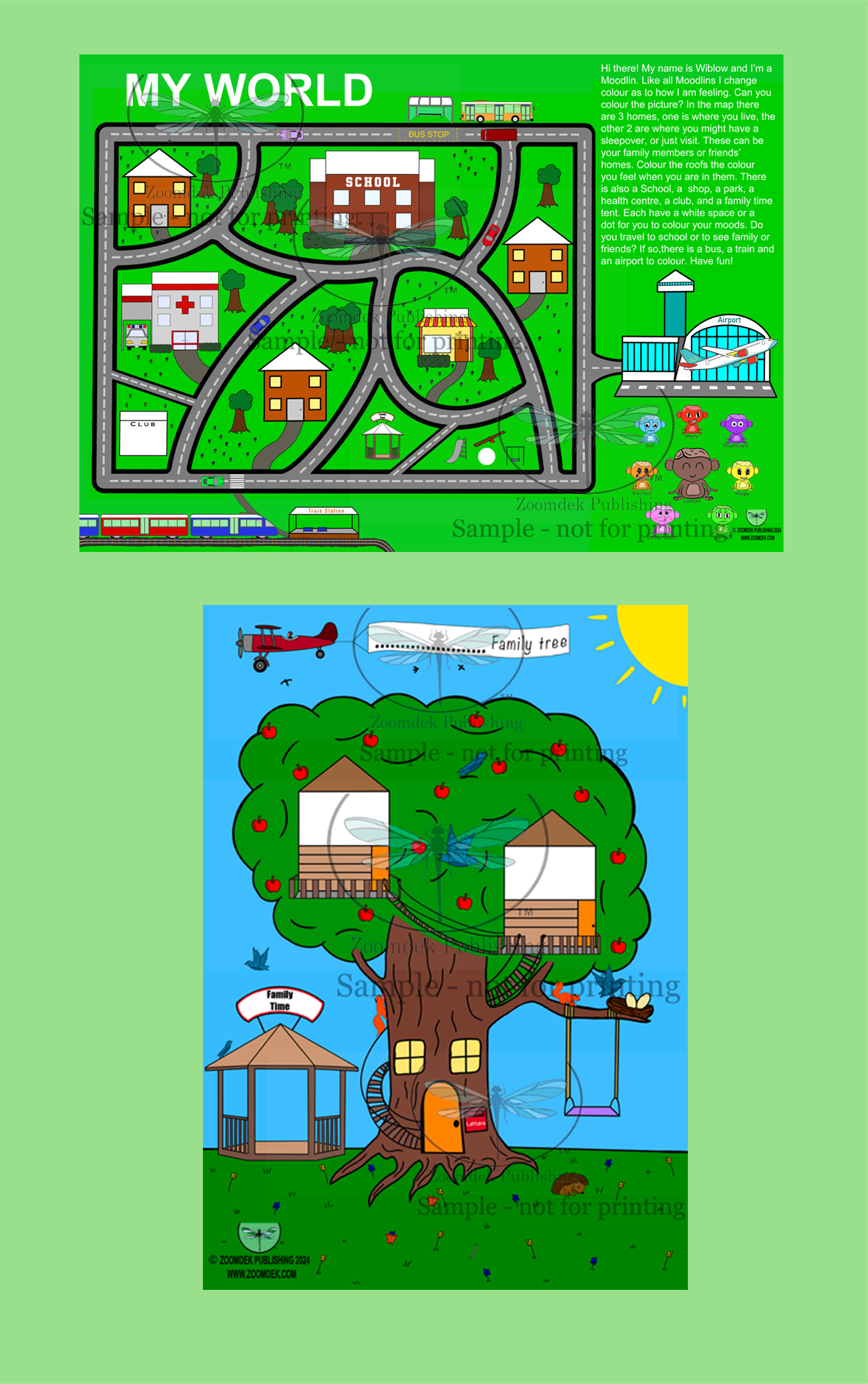
My world reflects a child or young person’s world they live in and navigate. Who is in their microsystem? There is a shop, a school, a health centre, a community club, a family time tent and a park. There are also 3 homes, one represents where the child lives, the other 2 are for what other homes they sleep in or spend time in, or would like to spend time in. Each roof is left white so the user can colour the roof matching the Moodlins emotion chart and colour of how they feel when they are in that particular home.
The buildings in the map each have an area to colour reflecting how the child feels when they are there. Who do they go with? What do they do there? How do they feel when there?
There is a bus stop, an airport and a train station if a child travels to see a parent, or a family member etc which can also be coloured in.
My World direct work sheet can open conversations. It is used as part of your assessment or to test your hypothesis evidencing from the child’s perspective of what systems they navigate and how they feel about it. Is the child safe in their environment? Do they have worries about being in a particular house or place? Are they happy or do they want to do more like access a particular club?
The family time tent is versatile. If a child is in care this could reflect how they feel about seeing certain family members at family time. If they are not looked after it can be used to simply ask what they do with their family for fun. Do they have movie nights, go to the cinema, football together etc.
My world will open conversation and offer you an insight into the child’s world. It can be used for evidence, for assessments and to photograph to upload on the child’s file. If the child doesn’t want to talk to you, or non-verbal, they can still colour how they are feeling.
My Family Tree
My Family Tree is a versatile direct work tool based on systems theory. This direct work can be used to ascertain the child’s views and voice. It is designed to be a conversational piece of work and to test your hypothesis. You can upload a photograph of My Family Tree onto the child’s file, use for evidence, gain views for s.7 reports and assessments.
My Family Tree for Looked after Children
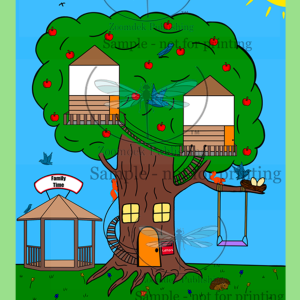
My Family Tree can be used for direct work with Looked After Children and forms part of their Life Story. Support the user to draw or stick photographs in one of the tree houses reflecting who they live with. The 2nd tree house can be used to stick or draw pictures of who the user has lived with or stays with for respite. It helps the user connect their wider family / network and who looks after them. It helps them understand their journey so far or current circumstances. The tree houses are connected to support understanding of where the user is going and returning to. Who is important to them? Who are their birth family? The family time gazebo is situated adjacent to the tree. The user can draw or stick photographs of birth family members they see. This is important for the users to understand their world, their identity, and where they came from, prepare them for family time visits. The letter box is to illustrate letter box contact with those who they continue to communicate with.
My Family Tree to support family separation
My Family Tree can also be used for a child to understand about parent separation, who they will be living with and who they will spend time with. It is designed to support the child’s understanding of change and routine.
It creates an opportunity for the professional when completing this direct work 1-1, a conversation about what happens in each of these homes, whether the child is happy or if there are any worries or concerns. The child can draw facial expressions on themselves and family members etc in the tree houses. If they see a parent for family time, they can draw in the tent. The homes can be anyone’s home the child spends time/ overnights in, to aid discussions.